← All guides

How to Auto-Publish AI Articles to WordPress Without Copy-Paste

How to Auto-Publish AI Articles to WordPress Without Copy-Paste

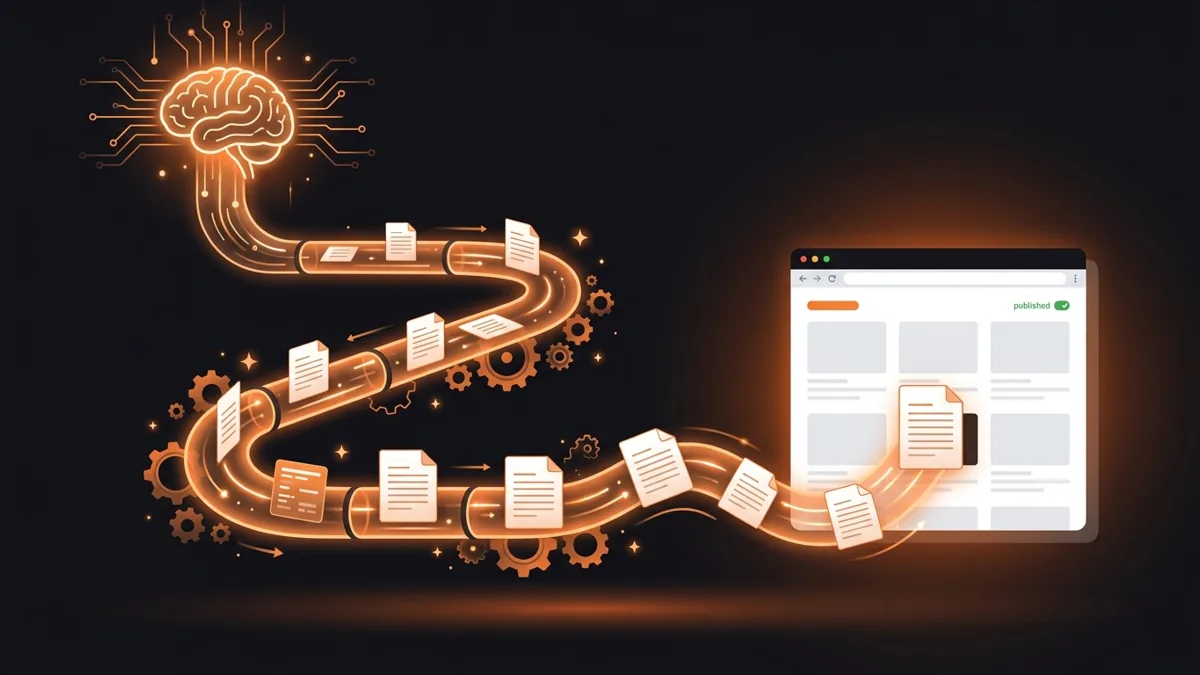
To auto-publish AI articles to WordPress without copy-paste, connect your site to Claude or ChatGPT through an MCP connector, then ask the AI to write and publish a post. It creates the article, adds a featured image and SEO fields, and saves it as a draft or publishes it directly on your site.

Why copy-paste quietly wastes your time

Copying from ChatGPT into the WordPress editor feels quick, but it costs you on every post. Formatting breaks, images do not come along, SEO fields and schema get skipped, and you spend minutes cleaning up what the AI already knew. Worse, it does not scale. Ten articles means ten manual pastes and ten rounds of fixing.

A direct connection removes all of that. The AI stops handing you text to paste and starts creating the finished post on your site.

The direct approach: connect with MCP

With an MCP connector, your AI assistant has real WordPress tools rather than just a text box. Instead of returning an article for you to copy, it creates the post on your site, with title, body, categories, tags, featured image and SEO meta included. The difference is the gap between "AI wrote some text" and "a publish-ready post appeared in my dashboard".

Step by step: from prompt to published

Once your site is connected, the workflow is simple and repeatable:

  1. Connect once using your site URL, admin username and an Application Password.
  2. Ask for a full article. For example: "Write a 1,200 word SEO article on <topic>, add a featured image, set the meta title and description, and save it as a draft."
  3. Review the draft in WordPress. It arrives fully formatted, with the image and SEO fields already filled in.
  4. Publish it yourself, or tell the AI to publish once you are confident.

There is no copy, no paste, and no reformatting. You spend your time reviewing quality, not moving text around.

Add images and SEO in the same request

The real time saver is that a capable connector handles the whole package in one go. In the same request that writes the article, the AI can:

  • Generate a featured image and attach it to the post.
  • Write descriptive alt text for accessibility and SEO.
  • Fill the meta title and description.
  • Add Article and FAQ schema so search and AI engines understand the page.

That is the difference between a rough draft and a post that is genuinely ready to publish.

Keep a human in the loop

Automation should not mean unattended publishing. The best practice is to have AI create drafts, review them, and approve. For bulk work, use an approval inbox so risky actions wait for your sign-off. You get the speed of automation without the risk of something wrong going live.

Reviewing also protects your SEO. AI-assisted content ranks and gets cited when it is accurate and adds real value, so a quick editorial pass is time well spent.

Does auto-published AI content hurt SEO?

Not if you review it. Search engines reward helpful, accurate content regardless of how it was drafted. Problems come from publishing unchecked, generic text at scale, not from using AI to draft. Have the AI create drafts, edit for accuracy, add your own insight or data, and publish with confidence.

Good prompts get better posts

The quality of an auto-published article depends heavily on the prompt. Vague prompts produce generic posts, while specific prompts produce publish-ready ones. Include these details when you ask:

  • The exact topic and angle, not just a keyword.
  • The target length, for example 1,200 to 1,500 words.
  • The audience and tone, such as "for small business owners, practical and friendly".
  • The structure you want, such as answer-first H2s and a FAQ.
  • The extras, like a featured image, meta description and internal links to two related posts.

A detailed prompt is the difference between editing for ten minutes and editing for ten seconds.

Where automation fits in a real workflow

Direct publishing is most powerful when it becomes routine. A simple weekly rhythm might look like this. On Monday you ask the AI to draft two articles from your content calendar, complete with images and SEO. On Tuesday you review and edit the drafts, adding your own examples. On Wednesday you tell the AI to publish the approved posts and add internal links from older articles.

The AI handles the mechanical work while you handle judgment and voice. That split is what makes a small team produce like a larger one, without drowning in copy and paste.

Common questions before you automate

A few concerns come up whenever someone moves from copy-paste to direct publishing. Here is how to think about them:

  • Will it publish something wrong? Not if you use drafts and an approval step. The AI proposes, you approve.
  • Can I still edit in WordPress? Yes. The AI creates normal posts you can open and edit like any other.
  • What about formatting and images? A capable connector handles both, so drafts arrive clean rather than as raw text.
  • Does it lock me in? No. You bring your own AI and connect over standard Application Passwords, so you can change tools or disconnect any time.

The bottom line

Copy-paste made sense when the only option was a chat window and an editor in two separate tabs. It does not make sense once your AI can reach your site directly. Connect once, ask for a complete article with an image and SEO, review the draft, and publish. That is the whole loop.

The result is a content process that scales with prompts instead of hours. You keep full editorial control through drafts and approvals, you avoid the formatting cleanup that eats time on every post, and you free yourself to focus on the parts only a human can do: strategy, voice, accuracy and the ideas worth writing about in the first place.

Publish once, then scale it

The payoff shows up when you do this regularly. Because the AI publishes directly, a weekly content routine that used to take hours of copy, paste and formatting becomes a few prompts and a review. You keep editorial control, and you get consistent output without the busywork.

wptaskify pricing showing bring-your-own-AI plans
Every wptaskify plan includes all the tools; you bring your own Claude or ChatGPT.

Frequently asked questions

Can AI publish articles directly to WordPress without copy-paste?

Yes. Through an MCP connector, the AI creates the post on your site directly, with images and SEO fields, so there is nothing to copy and paste.

Will auto-published AI content hurt my SEO?

Not if you review it. Have AI create drafts, edit for accuracy and add original value, then publish. Well-structured, factual AI-assisted content can rank and get cited.

Can the AI add a featured image and meta description too?

Yes. A capable connector generates a featured image, writes alt text, and fills the meta title and description in the same request.

Do I have to let the AI publish automatically?

No. You can have the AI save drafts and publish them yourself. An approval step lets you keep full control while still saving time.

Related guides

WPTASKIFY

Let AI write and publish to your WordPress, free to start

Bring your own Claude or ChatGPT and let AI write, optimize, sell and publish for you.

280 tools for WordPress, WooCommerce & Shopify Your own AI, no extra bill Nothing goes live without approval
Get started free →
Free forever plan · No credit card

← All guides